
Remembering Joan Rivers: The Woman Who Refused to Leave the Room
She conquered late night, survived a career implosion, turned the red carpet into television and kept a joke file big enough to outlive her. This is Joan Rivers in full.
By Nina BrooksPublished Updated 18 min read
Open Joan Rivers’ filing cabinet and the first surprise is how unfunny it looks: thousands upon thousands of index cards, typed, corrected and filed by subject. Marriage. Money. Age. Sex. Death. The woman who appeared to invent every insult at the speed of light had, in fact, built herself an arsenal.
The archive—roughly 65,000 to 70,000 jokes—explains her better than any famous punch line. Joan was quick because Joan was prepared. She revised, indexed and kept moving. At 75, she let a documentary camera watch her stare at an empty booking calendar as though it were a medical diagnosis. At 80, she was still performing, selling, interviewing and testing exactly how far a joke could go.
The voice came first—the rasp, the pointing finger, the question that was half invitation and half warning: Can we talk? Then came the speed. But the real story was work. She broke into rooms that did not expect a woman to control the monologue, blew up the biggest opportunity of her career, endured a family catastrophe in public, rebuilt herself in daylight, transformed the red carpet into entertainment and made selling jewelry feel like a nightclub set. Joan did not wait to be declared relevant. She clocked in and proved it.
Before the punch line
Joan Alexandra Molinsky was born in Brooklyn on June 8, 1933, and grew up in a Russian-Jewish family that later moved to Larchmont, New York. She graduated from Barnard College in 1954. The polished education and suburban expectations pointed toward stability; Rivers moved toward performance instead.
Before comedy paid, she took ordinary jobs and chased auditions. She worked in the Greenwich Village club world, wrote for television and passed through Chicago’s Second City orbit. The early rooms were crowded with performers who would define postwar American comedy, but the terms were different for a woman. A male comic could present neurosis as intellect. A woman discussing dating, body anxiety, marriage and ambition risked being reduced to confession.
Rivers made that double standard combustible. She did not ask the audience to regard female insecurity as delicate. She made it loud, specific and public. Her persona could be vain, wounded, ruthless and needy within the same minute. Instead of hiding the hunger for approval, she exaggerated it until the hunger became the joke.
That was the first great Joan Rivers invention: not self-deprecation itself, but self-deprecation used as a weapon. The joke landed on her first, then ricocheted toward beauty culture, marriage, celebrity and the audience’s own appetite for cruelty. She could appear to surrender all dignity while retaining total control of the room.
The night Johnny Carson said she would be a star
On February 17, 1965, Rivers made the appearance that changed her professional life. Sitting with Johnny Carson on *The Tonight Show*, after years of auditions and club dates, she received the sentence every struggling performer imagines: “You’re gonna be a star.”
The endorsement mattered because Carson’s desk was then one of American entertainment’s most powerful gates. Rivers became a frequent guest and, eventually, his permanent guest host. She could step into the chair without softening herself. Her monologue moved fast; her celebrity interviews could feel like affectionate interrogation. She was no longer a novelty in the format. She was one of its masters.
The relationship also became a story Rivers could never completely escape. Carson represented approval, access and a kind of television father figure. When she accepted an offer in 1986 to host a rival late-night show on a new network, the move was both historic and catastrophic.
The late-night leap — and the price of taking it
*The Late Show Starring Joan Rivers* made Rivers the first woman to host a late-night network talk show. It should have been remembered simply as a glass-ceiling moment. Instead, it became inseparable from the rupture with Carson.
Rivers said she tried to call him before the announcement became public. By her account, he hung up. The relationship ended, and she was never invited back to his show. Industry coverage turned the move into a story about loyalty and betrayal — a framing that risked obscuring the business reality. Rivers had spent years proving she could do the job. Fox offered her the job.
The show struggled and was canceled in 1987 after conflict with the network. Rivers lost the platform she had risked everything to take. Then the professional disaster became personal tragedy: her husband and manager, Edgar Rosenberg, died by suicide that August.
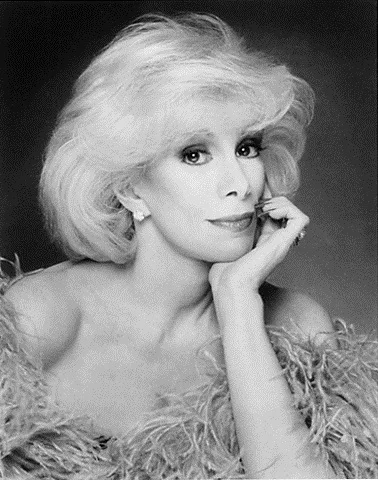
There is no clean motivational arc through what followed. Rivers and her daughter, Melissa, were grieving. The family faced financial and professional instability. Rivers later spoke about bankruptcy and about the practical terror of starting again. Her comedy absorbed the disaster because her comedy absorbed nearly everything, but turning pain into a line did not mean the pain was solved. It meant she could work while carrying it.
The comeback was not one comeback
The easy version says Joan Rivers fell and returned. The true version is more impressive: she returned repeatedly, in different forms, for different audiences.
Her syndicated *Joan Rivers Show* began in 1989 and won her the Daytime Emmy for Outstanding Talk Show Host in 1990. Daytime television gave her a room after late night had closed its doors. She could be warm, curious and still dangerous. The award was vindication, but it was not a final destination.
On Broadway, she co-wrote and starred in *Sally Marr...and Her Escorts*, inspired by Lenny Bruce’s mother, earning a Tony nomination in 1994. In retail television, she launched a jewelry line in 1990 that expanded into a durable fashion business. On red carpets, she and Melissa began asking celebrities who they were wearing, helping turn arrivals coverage into a distinct entertainment format. Later, *Fashion Police* converted those fleeting judgments into a weekly panel show.
Each reinvention used the same core skill: Rivers could make an audience feel that live television might slip its leash. A jewelry pitch could become stand-up. A red-carpet question could become confrontation. A fashion verdict could become a miniature roast. She understood that celebrity culture was not separate from comedy; it was one of comedy’s richest stages.
Joan and Melissa: family, work and survival
Melissa Rivers was never merely a supporting figure in her mother’s public life. She was a child inside the family crisis of 1987, then an adult collaborator in Joan’s reinvention. Their red-carpet work made their chemistry part of the product: Joan lunged toward the joke; Melissa could ground the exchange and keep the machinery moving.
Their closeness did not require a sentimental edit. The relationship was public, demanding and intertwined with business. That complexity was part of its force. Joan’s work frequently pulled family experience into view, and Melissa became both witness to and participant in the late-career ascent.
After Joan’s death, Melissa became the guardian of a legacy too large to reduce to a catchphrase. The joke archive, documentary record and continuing public conversation all preserve not just the famous lines but the method behind them.
The surgery jokes — what she said, and what should not be claimed
Rivers made cosmetic surgery a recurring subject because it sat at the intersection of her central themes: aging, beauty, money, shame and the brutal scrutiny of women. She spoke openly about having a nose job, facelifts, Botox and other procedures. She joked about wanting another facelift and treated her altered appearance as material before anyone else could use it against her.
That candor has also produced careless mythology. One frequently repeated claim assigns her an exact, enormous number of procedures. It came from comedy and tabloid repetition, not a reliable medical record, and should not be presented as fact.
The more meaningful point is not a number. Rivers understood that an older woman in entertainment could be mocked for aging naturally and mocked for trying not to age. She occupied the contradiction aggressively. Sometimes her jokes reinforced the harsh standards she was exposing; sometimes they made those standards look absurd. Often they did both at once.
Her face became part of the act, but it was not the whole act. Fixating on procedures can flatten a prolific writer, performer, host and businesswoman into a before-and-after photograph. Rivers herself kept returning the conversation to agency: if the culture was going to inspect her, she would narrate the inspection.
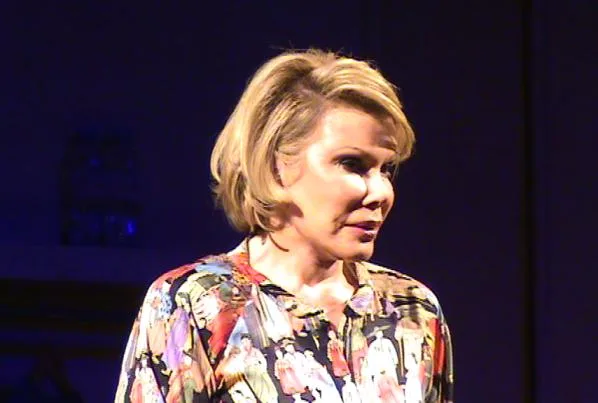
Twelve books and a life written in public
Rivers’ writing extended far beyond cue cards. Across 12 books she returned to ambition, family, survival, aging and the mechanics of performance. *Enter Talking*, published in 1986, traced the long apprenticeship behind the supposedly overnight breakthrough. *Still Talking* continued the story through fame and loss. *Bouncing Back* confronted recovery after catastrophe.
Her later titles became sharper extensions of the stage persona. *I Hate Everyone... Starting with Me* turned grievance into structure. *Diary of a Mad Diva*, published in 2014, won a posthumous Grammy for Best Spoken Word Album in 2015. The award corrected a detail sometimes blurred in retellings: Rivers had been nominated for comedy recording decades earlier, but her Grammy win came after her death.
The books matter because they preserve her control of the narrative. Rivers was interviewed constantly, profiled often and frequently misunderstood. In her own work, she could show the years of rejection behind the velocity and the fear beneath the ambition.
A Piece of Work: the documentary that showed the engine
The 2010 documentary *Joan Rivers: A Piece of Work* caught Rivers in her 75th year without embalming her. It showed the calendar, the staff, the travel, the empty dates and the need to keep earning attention. Glamour appeared as infrastructure: assistants, bookings, clothes, schedules and a performer measuring her worth in work.
One image became especially revealing — Rivers looking at a sparse calendar with dread. The scene punctured the fantasy that longevity produces peace. Success had not cured her fear of disappearance. It had trained her to recognize how quickly disappearance could happen.
That vulnerability made the documentary more than a career survey. It showed comedy as physical and administrative labor. The legend was still hauling herself through airports and rooms, searching for the next audience. The film did not ask viewers to pity her. It asked them to understand the cost of being Joan Rivers.
Watch
Clips tied to this story.
The red carpet, Fashion Police and the ethics of the joke
Rivers’ late career placed her at the center of a celebrity culture she could puncture and amplify at the same time. Her red-carpet work helped turn fashion identification into live entertainment. *Fashion Police* made critique a weekly sport.
The show could be thrillingly fast and undeniably cruel. Rivers’ defense was often the logic of the roast: the powerful, the famous and the professionally styled were fair targets. Yet not every target possessed equal power, and not every joke aged well. Her legacy cannot be made honest by pretending the harm never existed.
What separates serious remembrance from uncomplicated tribute is the ability to hold both truths. Rivers expanded what women were permitted to say onstage. She also used shock, stereotypes and humiliation in ways that drew legitimate criticism. She believed comedy needed freedom to risk offense. Audiences retained the freedom to answer back.
The argument around her work remains alive because the work remains alive. A harmless comic rarely produces a decades-long debate about the boundary between fearless and cruel.
QVC, commerce and the performance of selling
In September 1990, Rivers entered television retail with jewelry. The business grew into clothing and accessories and became one of her most durable reinventions. It also demonstrated her lack of snobbery about platforms. Late night, daytime, a red carpet, a theater, a shopping channel — if there was a camera and a live audience, she could work.
Selling did not sit outside her comic identity. She told stories, created urgency, improvised and made viewers feel included. The products mattered, but so did the event of Joan presenting them. Long before creators were expected to be entertainers, retailers and personal brands at once, Rivers had built that combination on television.

The final procedure and the facts of her death
On August 28, 2014, Rivers underwent an outpatient laryngoscopy and upper gastrointestinal endoscopy in Manhattan while doctors evaluated voice changes and reflux. She was sedated with propofol. During the procedure she suffered hypoxic arrest and stopped breathing. She was taken to Mount Sinai Hospital and placed on life support.
Joan Rivers died on September 4, 2014. She was 81.
The medical examiner described the cause as anoxic encephalopathy due to hypoxic arrest during the procedures and classified the manner of death as a therapeutic complication. That language matters: it describes a recognized complication of medical treatment and is not, by itself, a finding of homicide or negligence.
A separate regulatory investigation documented serious deficiencies at the clinic, including failures involving monitoring, consent, documentation and the presence or actions of personnel. Those findings should not be collapsed into the medical examiner’s classification; they are distinct parts of the record. Melissa Rivers later reached an undisclosed settlement in the family’s malpractice case. No reliable public settlement figure should be invented.
The facts are stark because the procedure was routine enough to feel ordinary. The loss was not. Tributes followed from comics, hosts, actors, designers and viewers who had watched Rivers cycle through generations of television without surrendering the microphone.
The 70,000 jokes she left behind
In 2025, a major exhibition opened around Rivers’ archive, including the vast joke file she built and maintained across her career. The cards reveal something live performance can hide: spontaneity was supported by relentless construction. Topics were sorted; formulations were tested; old material stayed available for new contexts.
The archive also makes her unusually legible to future readers, researchers and comedians. They can see not only what she said but how a public voice was manufactured over decades. The collection is an argument against the idea that comic instinct arrives fully formed. Rivers’ instinct had an index.
Her influence appears wherever a woman turns intimate embarrassment into authority, refuses the instruction to become quieter with age, or moves between entertainment and commerce without apologizing for the transaction. Influence does not mean imitation. Very few people could imitate that rhythm without sounding like a costume.
The last word is still hers
Joan Rivers’ career asks a question larger than whether every joke survives: who is allowed to remain visible, ambitious and unruly for an entire lifetime?
She was praised as a pioneer and punished as a traitor. She was dismissed as finished and returned through another door. She made herself the joke before others could, then made the audience confront why the joke was available. Her work could liberate and wound, sometimes in the same breath.
The best remembrance does not sand away those contradictions. It sees the historic first, the ferocious worker, the grieving widow, the mother, the seller, the author, the red-carpet architect, the surgical self-parodist and the comic who refused retirement as parts of one project: staying in the conversation.
The joke file never closed because Joan Rivers never treated laughter as magic. She treated it as work — written down, filed carefully, carried forward and delivered as if she had just thought of it.
The photos · 8
The backstory
Verified moments, in order.
Joan Rivers: 29 moments that made an original
From the long club apprenticeship and Carson breakthrough to late-night history, public loss, reinvention and the vast joke archive she left behind.
- June 8, 1933
Born in Brooklyn
Joan Alexandra Molinsky is born in Brooklyn and later grows up in Larchmont, New York.
Graduates from Barnard
She completes her Barnard College degree before pursuing performance rather than a conventional professional path.
A brief first marriage
Her marriage to James Sanger is annulled in the same year.
Second City and the club apprenticeship
Rivers works through the early-1960s comedy world, sharpening material in rooms where women rarely controlled the monologue.
- February 17, 1965
The Tonight Show breakthrough
After years of club work and auditions, Rivers appears with Johnny Carson and hears the prediction that she will be a star.
Marries Edgar Rosenberg
Rivers marries producer Edgar Rosenberg, who later becomes closely involved in her career.
Melissa Rivers is born
Joan and Edgar welcome their daughter, Melissa, who will later become Joan’s television collaborator and legacy keeper.
Mother and daughter in public
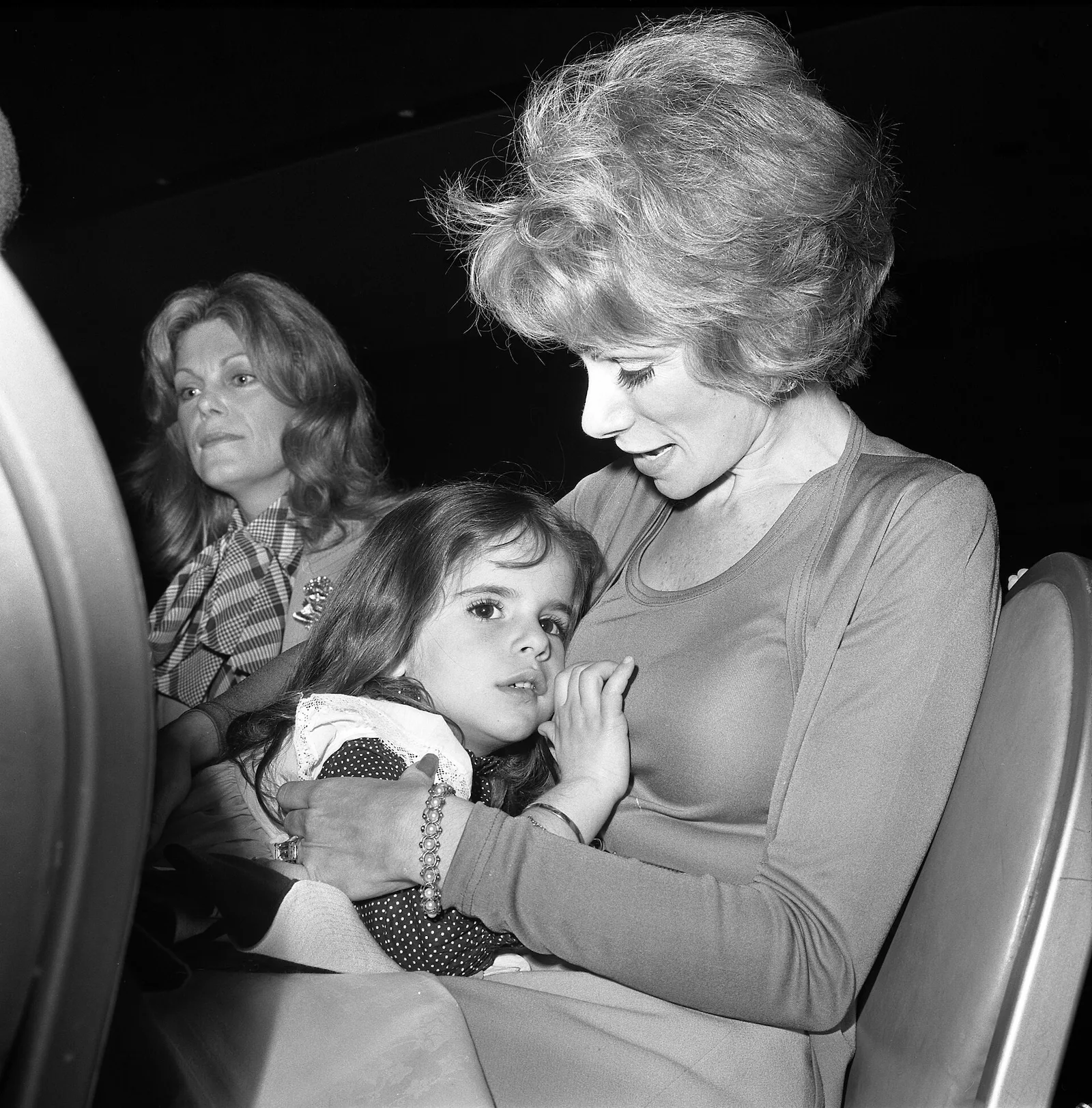
Joan is photographed holding young Melissa at a fashion event, decades before their red-carpet partnership.
A landmark comedy album
What Becomes a Semi-Legend Most? earns a Grammy nomination and becomes one of her signature recordings.
- May 1986
The late-night leap
Rivers leaves her guest-host role to launch The Late Show Starring Joan Rivers, becoming the first woman to host a late-night network talk show.
- Flashpoint
Fox cancels The Late Show
The ambitious move collapses amid ratings pressure and network conflict; her relationship with Carson never recovers.
- August 14, 1987Flashpoint
Edgar Rosenberg dies
Her husband dies by suicide after the show’s collapse, beginning the most painful period of Rivers’ life.
Broadway debut
Rivers makes her Broadway debut in Fun City.
The Joan Rivers Show begins
Syndicated daytime television gives Rivers a new platform and starts a crucial professional recovery.
A Daytime Emmy and a new business
She wins Outstanding Talk Show Host and launches her television jewelry business, opening another long-running career.
A Tony nomination
Sally Marr...and Her Escorts, co-written by and starring Rivers, earns her a Best Actress in a Play nomination.
The modern red-carpet era
Joan and Melissa begin their influential awards-arrivals commentary, turning fashion questions into entertainment.
A durable television reinvention
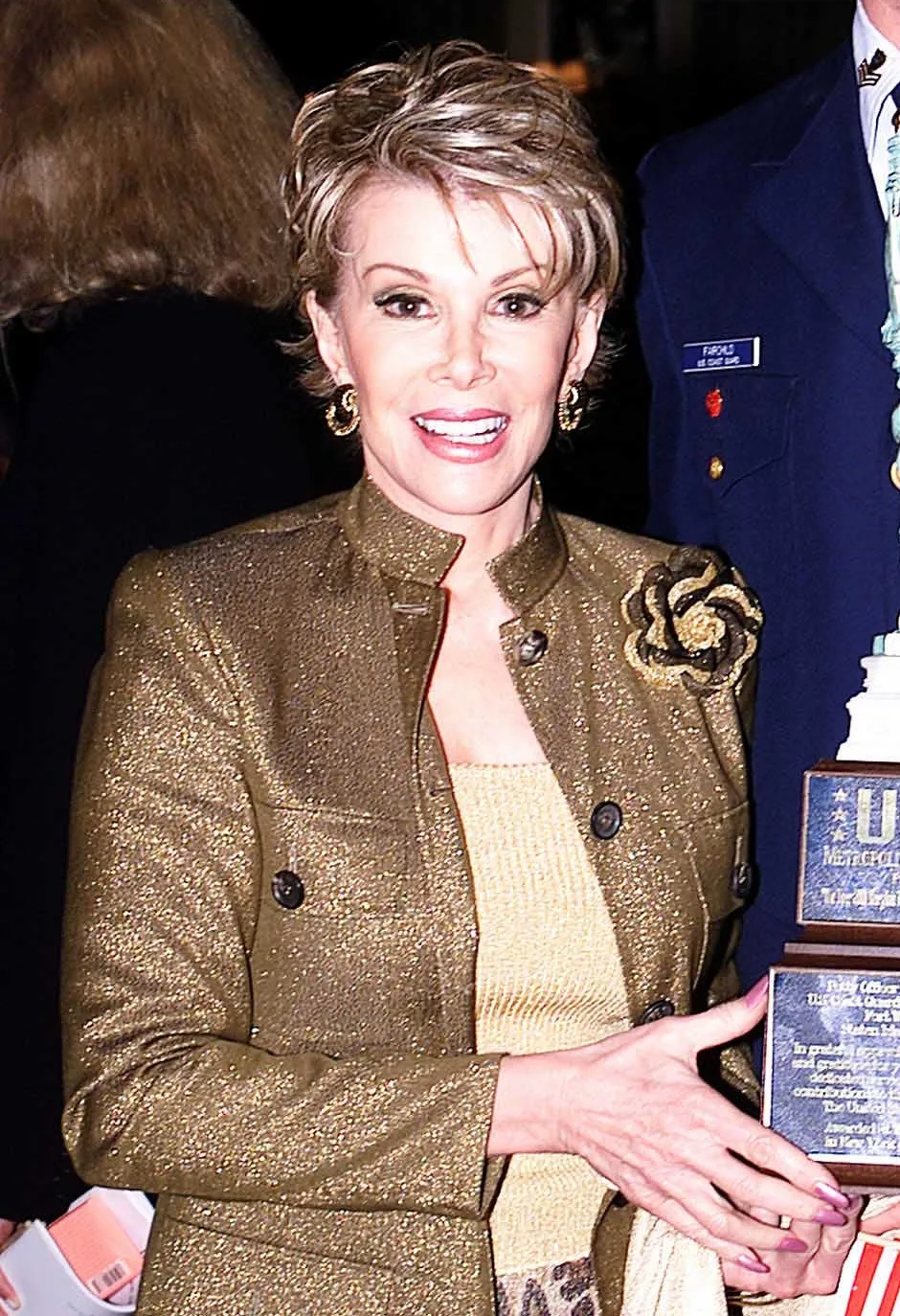
By the new century, Rivers is a host, red-carpet fixture, author and retail entrepreneur operating across audiences.
Still working the stage
Rivers performs Life in Progress, demonstrating the live-work discipline that remained central to her identity.
- May 11, 2009
Wins Celebrity Apprentice
At 75, Rivers wins the competition and directs the prize to a New York meal-delivery charity.
A Piece of Work
The documentary follows her crowded professional life and fear of an empty calendar, revealing the labor beneath the persona.
Fashion Police
Rivers becomes the defining host of the weekly celebrity-fashion panel and returns to the center of pop culture.
Joan and Melissa at Fashion Week

The pair remain inseparable from the fashion-media world they helped transform.
I Hate Everyone arrives
Her late-period book converts complaint, provocation and self-attack into a tightly structured comic manifesto.
Diary of a Mad Diva
Her final book extends the stage persona onto the page and later earns a posthumous spoken-word Grammy.
- August 28, 2014Flashpoint
A routine visit becomes an emergency
Rivers suffers hypoxic arrest during outpatient procedures and is transferred to Mount Sinai Hospital.
- September 4, 2014
Joan Rivers dies at 81
Her death prompts tributes across comedy, television, fashion and New York.
A posthumous Grammy
Diary of a Mad Diva wins Best Spoken Word Album.
The medical case settles
Melissa Rivers reaches an undisclosed settlement in the family’s malpractice case; no public amount is established.
The joke archive opens
A major exhibition brings her roughly 65,000–70,000 indexed jokes into public view as a record of craft and obsession.
More like this

Celebrity
Hollywood Remembers Hayden Panettiere At Emotional Memorial As Mom Lesley Vogel Addresses Absence
Stars gathered for a tribute service over the weekend, while a.
12h ago

Celebrity
Leonardo DiCaprio, Robert De Niro, and Tobey Maguire Grab Malibu Dinner With Gavin Newsom
Hollywood heavyweights Leonardo DiCaprio, Robert De Niro, and Tobey Maguire shared an exclusive meal with California Governor Gavin Newsom at Nobu Malibu.
Sep 20, 2026

Celebrity
Kim Kardashian and Lewis Hamilton Take On London on Lime Bikes
The reality star and the racing driver enjoyed electric bike rides and afternoon tea while in the UK for a major SKIMS launch.
Sep 19, 2026
Get the pop news brief
One daily email. The biggest celebrity, music and TV stories, no filler.
People also ask
- When was Joan Rivers born?
- Joan Rivers was born Joan Alexandra Molinsky in Brooklyn on June 8, 1933.
- When did Joan Rivers die?
- She died in Manhattan on September 4, 2014, at age 81, one week after suffering hypoxic arrest during outpatient procedures.
- What was Joan Rivers’ cause of death?
- The medical examiner listed anoxic encephalopathy due to hypoxic arrest during laryngoscopy and upper gastrointestinal endoscopy with propofol sedation, and classified the manner as a therapeutic complication.
- Was Joan Rivers the first woman to host a late-night network show?
- Yes. The Late Show Starring Joan Rivers launched in 1986, making her the first woman to host a late-night network talk show.
- How many plastic surgeries did Joan Rivers have?
- There is no reliable verified total. Rivers openly discussed facelifts, Botox, a nose job and other procedures, but the huge exact number repeated online originated as comedy and tabloid mythology rather than a medical record.
- How many books did Joan Rivers write?
- Rivers wrote 12 books spanning memoir, humor, advice and fiction. Her final book, Diary of a Mad Diva, won a posthumous Grammy for its spoken-word recording.
- What was Joan Rivers’ relationship with Johnny Carson?
- Carson gave Rivers her decisive television breakthrough and later made her his permanent guest host. Their relationship ended after she accepted a rival late-night show in 1986.
- What is in the Joan Rivers joke archive?
- The archive contains roughly 65,000 to 70,000 jokes on index cards organized by topic, preserving both her material and her working method.
Reader reaction
Loading comments…